
Diverter: Complete Guide to Types, Uses, Benefits & Installation
Table Of Content
Table of Contents
What Is a Diverter in Plumbing?
A diverter is a plumbing device that directs water from one outlet to another within the same plumbing system. Instead of requiring separate pipelines for each fixture, a Grafdoer diverter allows a single water supply to serve multiple outlets—such as a wall-mounted shower, an overhead rain shower, or a bathtub spout with a hand shower.
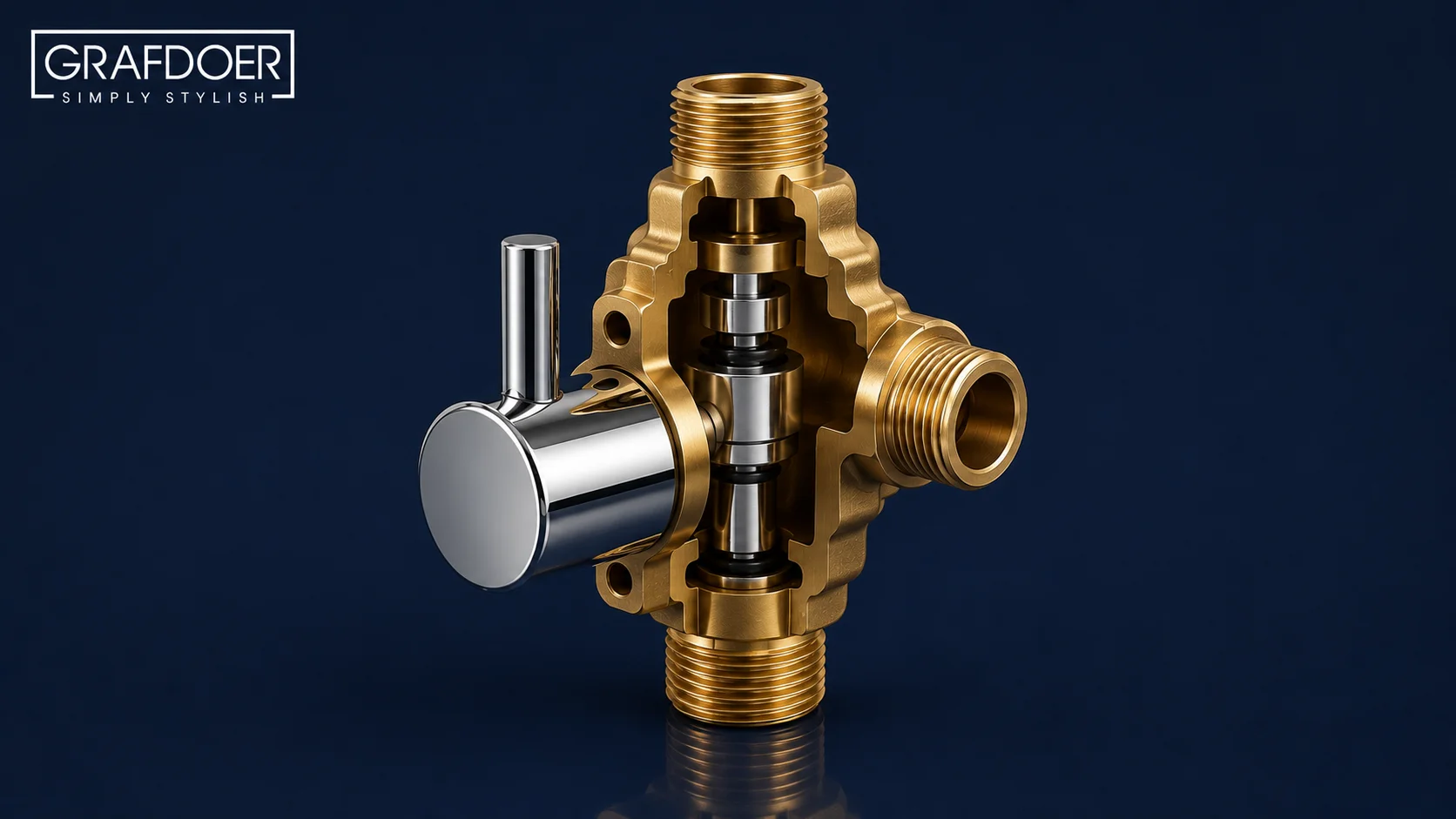
Mechanically, most Grafdoer diverters operate using an internal sliding or rotating mechanism (often a ceramic disc or spool valve) that opens or blocks specific water channels depending on the selected setting. When you turn the diverter knob or lever, the water is “diverted” from one outlet and redirected to another, providing convenient control over multiple shower or bath functions from a single water source.
How Does a Diverter Work: Step by Step
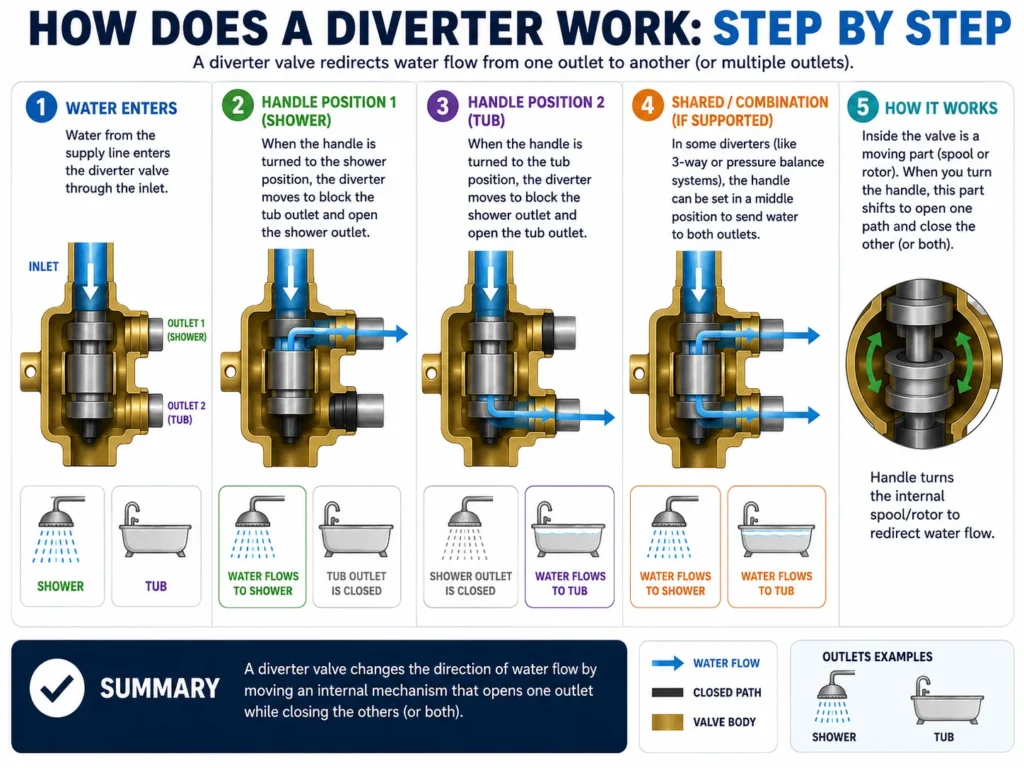
At its heart the operation of a diverter is based using a single principle: the controlled redirection of the flow of water and pressure.
- The user operates the control, such as turning a knob or moving a lever.
- The internal cartridge, spool, or disc shifts position inside the valve.
- The existing water pathway closes as the mechanism blocks the current outlet.
- A new water pathway opens toward the selected outlet.
- Water is redirected through the open passage by water pressure.
- Water exits through the chosen outlet, while the remaining outlets stay closed or restricted.
This is the reason why diverters are often referred to as “flow-switching valves.” The internal mechanisms determine just how well the diverter works as well as how long it can last and if it leaks in time that’s why the choice of material (discussed in the future) is crucial.
What Are the Different Types of Grafdoer Diverters?
1. Two-Way Diverters
The water flow is switched between two outlets, for instance, between the shower and a spout. They’re the most popular type that are found in bathrooms of homes all over India.
2. Three-Way Diverters
It is used when a bathroom has three outlets, for example the overhead shower as well as a shower hand. It is popular in bathrooms with mid-to-high-end designs.
3. Concealed Diverters
It is mounted inside the wall with only the knob or the plate accessible. They give a sleek minimalist appearance and are becoming more popular in contemporary Indian homes as well as commercial projects.
4. Exposed Diverters
The wall is hung and visible with the pipework. They are easy to maintain and install and are often utilized in mid- and low-cost projects, and also retrofits.
5. Concealed Diverter Cartridges
A specific part of hidden systems — usually ceramic-based — which controls the flow-switching mechanism. The quality of the cartridge is among the main factors affecting long-term diverter efficiency.
Why Do Bathrooms Need Diverters?
- For Functional Flexibility:- A diverter lets the bathroom be used for many functions for example, a quick wash using the hand shower or a refreshing rinse in an overhanging shower, or even filling up a bucket with a spout all with one source point.
- For Space and Cost Efficiency:- Without diverters, every fixture would require its own dedicated supply line, which would increase the costs of material and installation time. Diverters make this one point that is manageable.
- For Modern Bathroom Design:- As Indian homeowners increasingly choose rainfall showers and hand-showers and other bathroom designs that can be multi-functional diverters have become almost a standard requirement, rather than being a luxurious accessory.
What Should Homeowners Look for in a Diverter?
- Material Quality :- Diverters made of brass with Chrome or PVD (Physical Vapor Deposition) finishes are able to withstand corrosion better than alloys with lower grades which is a significant element given the differing water quality in Indian cities.
- Cartridge Type:- Ceramic disc cartridges typically provide more smooth operation and a longer lifespan when compared to plastic or rubber-based mechanisms, particularly in daily usage.
- Ease of Maintenance:- Diverters that have replaceable cartridges enable easy servicing without having to replace the entire fitting which is a sensible option to ensure long-term security.
- Compatibility:- Before buying, homeowners must verify that the diverter fits the pipe size they have in place and wall-mounting depth (for concealed models) as well as the amount of outlets they require.
- Warranty and After-Sales Support:- Since diverters are utilized frequently throughout the day, manufacturers’ warranty and the availability in spare parts (like cartridges) are beneficial as long-term concerns.
What Should Contractors Know About Installing Diverters?
- Installation Depth Matters:- For concealed diverters, the rough-in bodies must be installed in the proper depth and in the proper alignment at the initial plumbing fix -prior to tile. Incorrectly doing this can lead to damaging tiles in the future for repair.
- Pressure Compatibility:- Diverters must be aligned to the pressure requirements of the building – whether it’s pump-assisted, gravity-fed or pressurized systems to avoid issues with flow and premature wear.
- Standardization Across Projects:- For contractors who work on several units (apartments or hotels, villas) , using a common diverter range throughout a project makes it easier to procure spare parts, management, as well as future servicing.
- Testing Before Tiling:- Diverter bodies concealed in the walls should be tested under pressure prior to walls being finished. Post-installation repairs can be costly and disruptive.
Features of Grafdoer Diverters
1. Construction & Build Quality
- Brass body construction with anti-corrosion finishes for long-lasting durability.
- Some models are constructed from DZR (Dezincification Resistant) brass, which is waterproof and minimizes noise and vibration (Class “A” rating).
- Ceramic cartridge mechanisms designed to ensure easy, long-term operation.
2. Flow Control & Diversion
- The diverter allows users to switch water between outlets — such as a showerhead, hand shower, or bath spout — by turning a knob or lever.
- The DCB-125 model features 2 water inlets (hot and cold) and 5 outlets, which can serve a multi-function head shower, spout, body jets, hand shower, and more.
- An integrated diverter enables quick switching between outlets for a seamless shower or basin experience.
3. Temperature Control
- Hot & cold water inlet mixing.
- Left-to-right lever for temperature adjustment.
- Thermostatic models maintain constant preset temperature despite pressure fluctuations.
- Built-in temperature limiter at 38–40°C to prevent scalding.
4. Installation Types
- Available in both concealed and visible (exposed) configurations to accommodate different project needs.
- Concealed installation keeps the wall area neat while simplifying maintenance through well-designed exposed parts.
- Easy to install and compatible with standard plumbing.
5. Variants
- 2 inlet & 2 outlet models
- 2 inlet & 3 outlet models
- Up to 5 outlet models (DCB-125)
- Single lever concealed mixer & diverter combos
6. Corrosion-Resistant
- Built with anti-corrosion finishes that protect against rust and degradation over time.
- DZR brass material resists dezincification, making it ideal for areas with hard or chemically treated water.
- Ensures long-term performance even in humid bathroom environments.
- Suitable for Indian water conditions where mineral content and water quality can vary significantly.
7. Value Proposition
- Grafdoer diverters deliver performance comparable to premium brands at significantly better prices, making advanced thermostatic technology accessible to Indian households without compromising on quality, and offering solid warranty coverage.
Frequently Asked Questions About Bathroom Diverters
What is the difference between a diverter and a mixer?
A mixer combines hot and cold water and controls overall flow and temperature, while a diverter redirects the already-mixed water to a chosen outlet (such as a shower or spout). Many bathroom fittings combine both functions in a single unit.
Can a diverter be installed in an existing bathroom without major renovation?
Exposed diverters can often be retrofitted with minimal disruption since they sit on the wall surface. Concealed diverters, however, typically require wall-opening work and are best planned during renovation or new construction.
How long does a diverter typically last?
With proper installation and reasonable water quality, a good-quality brass diverter with a ceramic cartridge can last many years. Lifespan depends heavily on water pressure, water quality, and usage frequency — and cartridges may need periodic replacement.
Is a three-way diverter better than a two-way diverter?
It depends on the bathroom’s fixture count. A three-way diverter is necessary only if there are three outlets to manage (e.g., spout, overhead shower, hand shower). For simpler setups with two outlets, a two-way diverter is sufficient and more cost-effective.
Do diverters need regular maintenance?
Yes — periodic checking for leaks, smooth operation of the knob/lever, and occasional cartridge cleaning or replacement helps maintain performance, especially in areas with hard water.
Are concealed diverters more expensive than exposed ones?
Generally, yes — concealed diverters cost more due to the additional wall-installation work and the cleaner finish they provide. However, many buyers consider the aesthetic and space benefits worth the additional cost.
Also Read:- A Simple Guide to Thermostatic Diverters and Their Benefits
-
 October 1, 2026
Types of Toilets: A Simple Guide to Choosing the Right One
-
 September 30, 2026
Bathroom Fittings Buying Guide: What to Consider Before You Buy
-
September 22, 2026
Types of Wash Basins: How to Choose the Right Design for Your Bathroom