
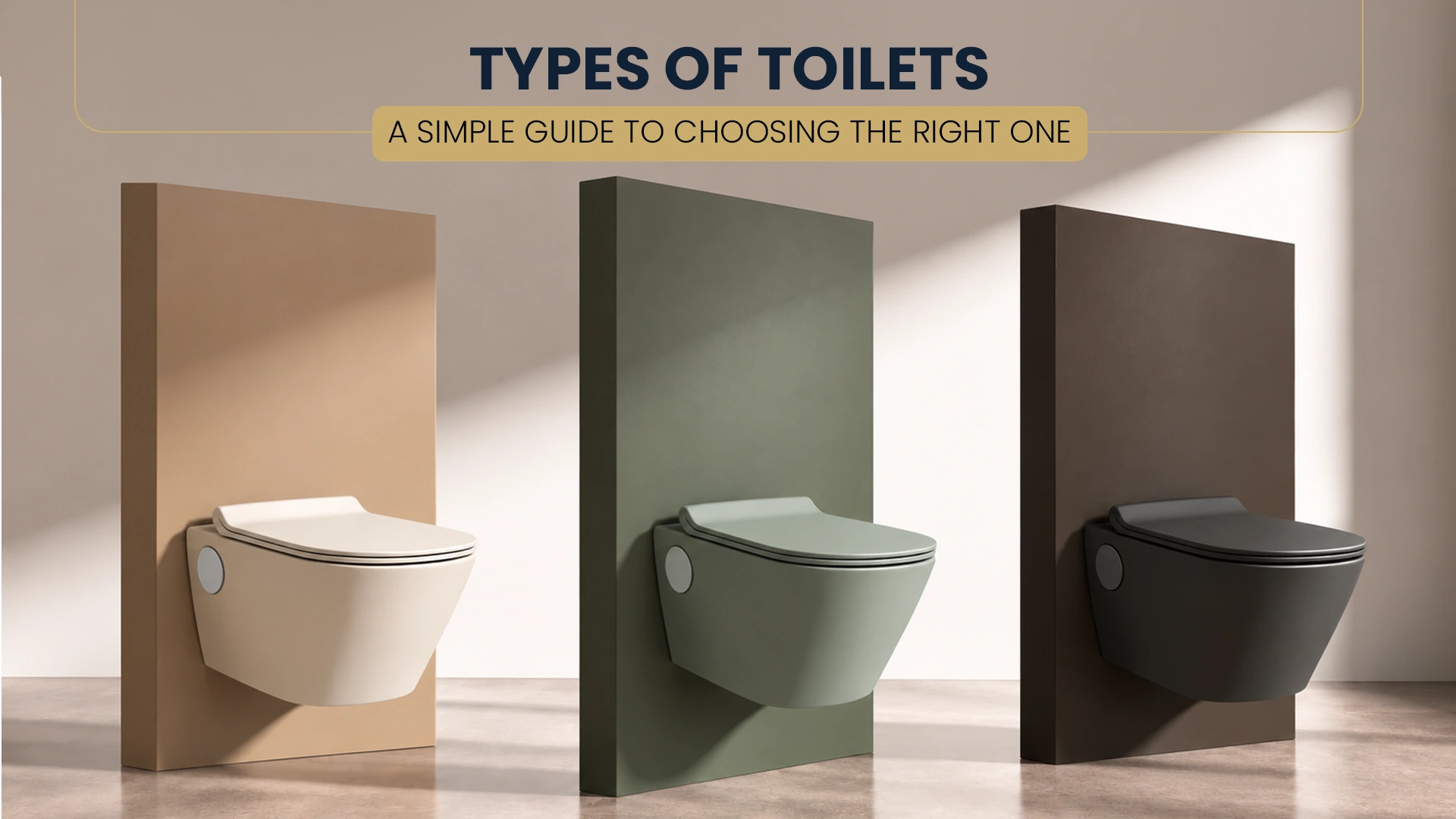
Types of Toilets: A Simple Guide to Choosing the Right One
Table Of Content
Table of Contents
Choosing a toilet probably isn’t something you thought you’d need to spend much time on.
You walk into a bathroom showroom, see a few different designs, and they can start looking pretty similar after a while. But look a little closer, and you’ll notice that toilets come in quite a few different types. Some are compact and practical, some are space-efficient, and some simply give the bathroom a more modern look.
So how do you choose the one that you should opt for? That really comes down to your bathroom, your plumbing arrangement, your space and naturally depends on your preferences.
Let’s look at the different types of toilets you’ll come across, starting with some of the most common ones.
1. One-Piece Toilets
A one-piece toilet is exactly what it sounds like. The bowl and the tank are constructed as a single unit rather than two distinct parts.
A major benefit of one-piece toilets is that there are fewer joints and crevices which prevents the accumulation of dirt and dust. This makes cleaning slightly easier.
And because the tank and bowl form a single unit, they tend to have a fairly compact look.
One-piece toilets are a good choice if you want something that looks clean, feels sturdy, and doesn’t make the bathroom look too busy.
2. Wall-Hung Toilets
In Wall-hung toilets, the toilet bowl is fixed to the wall, while the cistern and other plumbing components are concealed behind the wall. So when you look at the finished bathroom, you mainly see the bowl.
It looks sleek. And it can make the bathroom feel more open, especially when you’re working with limited space.
There’s another practical advantage too. Because the toilet doesn’t sit directly on the floor, cleaning underneath it is much easier. Of course, wall-hung toilets require the right installation and wall support, so they’re something you’ll want to plan before the bathroom work begins.
3. EWC (European Water Closet)
EWC stands for European Water Closet. In simple terms, it refers to the seated toilet style that’s widely used in modern bathrooms.
Unlike a traditional Indian-style pan toilet, an EWC allows you to sit while using it. You’ll find them in homes, offices, hotels, restaurants, and pretty much every type of modern bathroom.
EWCs are available in different designs too. You can find one-piece models, wall-hung models, and other variations depending on the bathroom layout and your preferences.
4. Pan Toilets
Pan toilets are quite different from the seated toilet designs we’ve just talked about.
They’re designed for squatting rather than sitting, with the user placing their feet on either side of the pan. They’re still commonly found in many Indian homes and public or commercial spaces, particularly where a squat toilet is preferred.
Pan toilets are simple and functional, but need a compatible bathroom design and drainage system.
But, if you are simply replacing an existing toilet it may be wise to check the plumbing arrangements first. You don’t want to buy your new toilet only to discover later on that your bathroom needs extensive upgrades to fit it.
Other Toilet Variations to Know
While browsing toilet sites, you’ll frequently encounter terms like rimless, P-trap, S-trap, and siphonic. These aren’t necessarily separate toilet types in the same way that a one-piece or wall-hung toilet is.
Instead, they describe things like the toilet’s design, trap arrangement, or flushing system.
Still, they’re important to know.
Rimless Toilets
Traditional toilets have a rim around the inside of the bowl from which water flows during flushing. What differs about a rimless toilet is that it doesn’t have that typical rim.
Instead, the water is designed to flow around the bowl in a way that helps clean more of its surface during a flush.
The main advantage is hygiene and easier cleaning. There are fewer hidden areas for dirt and bacteria to collect.
If ease of keeping your toilet clean is a top priority for you then you should consider a rimless design.
P-Trap Toilets
Here’s a term you’ll probably hear when discussing bathroom plumbing: P-trap.
The trap is the bent or curved part of the toilet where the waste exits. The purpose of this is to prevent sewer gases from escaping into the bathroom.
In a P-trap toilet, the outlet connects horizontally towards the wall. That makes it suitable for bathrooms where the drainage connection is positioned through the wall.
So if you’re choosing between a P-trap and an S-trap, don’t just pick whichever one looks better. Your existing plumbing setup matters here.
S-Trap Toilets
S-trap toilets work on the same basic principle, but the waste outlet goes down through the floor rather than horizontally through the wall.
They’re commonly used where the drainage pipe is located in the floor.
This is why trap type is something you should check before buying a toilet. The toilet needs to work with the way your bathroom’s plumbing is set up.
If you’re renovating from scratch, you have more flexibility. If you’re replacing an existing toilet, though, it’s usually best to work with the existing drainage arrangement unless you’re prepared for additional plumbing work.
Siphonic Toilets
Siphonic toilets rely on a siphoning action to help dislodge the waste along the trapway as you flush. The result is generally a strong and efficient flush, with water helping to create the pressure needed to clear the bowl.
So, Which Toilet Should You Choose?
There isn’t one toilet that’s perfect for every bathroom.
A wall-hung toilet might make sense if you’re going for a sleek, contemporary look and want to make cleaning the floor easier. If you just want something basic, long-lasting, and easy to look after then a one piece toilet is a good option.
P-trap and S-trap become important when it comes to plumbing. And if hygiene and easier cleaning are priorities, a rimless toilet may be worth looking at. Siphonic flushing, meanwhile, is something to consider when you’re comparing flushing performance.
The best choice really comes down to how your bathroom is designed and how you plan to use it.
Find the Right Toilet for Your Bathroom with Grafdoer
At Grafdoer, we offer different designs, installation styles, trap configurations and flush types to give our customers the best experience.
Our goal has always been to provide a diverse array of sanitaryware options for people to easily find a toilet that works as well as it looks.
-
 October 1, 2026
Types of Toilets: A Simple Guide to Choosing the Right One
-
September 30, 2026
Bathroom Fittings Buying Guide: What to Consider Before You Buy
-
September 22, 2026
Types of Wash Basins: How to Choose the Right Design for Your Bathroom


